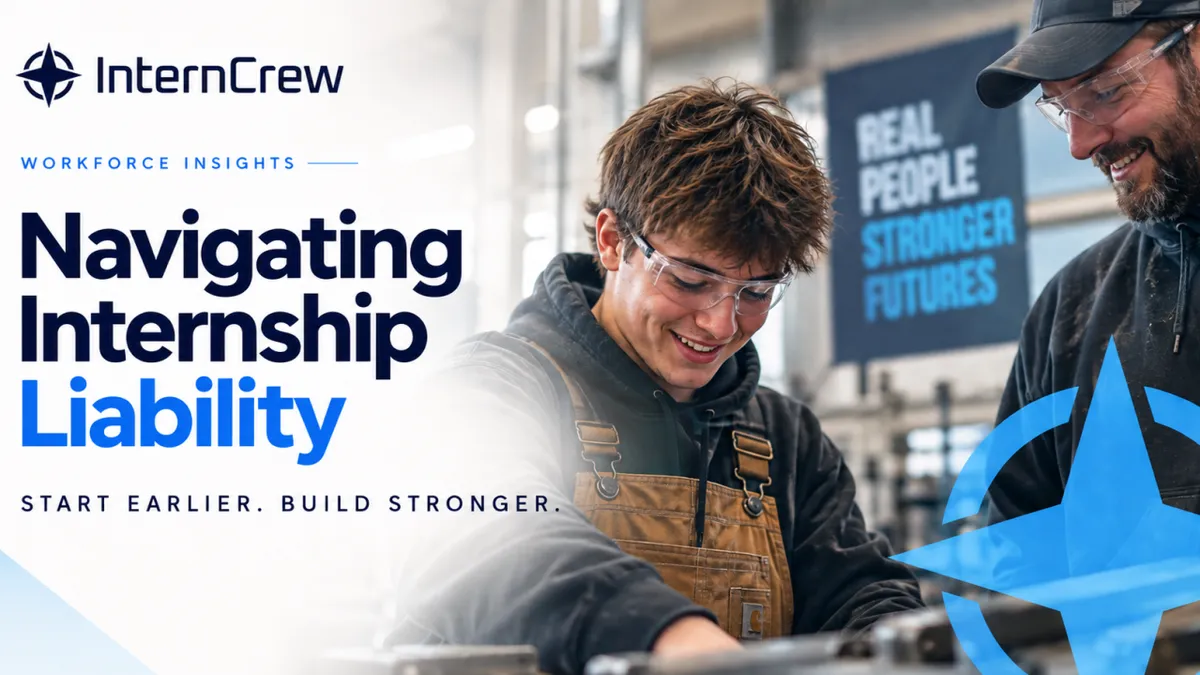

Why InternCrew, why now, and why every employer can open the door
Somebody gave you your first yes.
Maybe it was a manager who took a chance on a kid with a thin résumé. A foreman who said, “Show up Monday at six.” A clinic, a crew, or a bank branch that let you try.
Think about where you’d be without it.
I’ve spent 15 years in payroll, HR and analytics. Before that, I was a yacht broker. Every chapter taught me the same lesson: work builds people. It builds confidence, judgment and grit that no classroom or screen can fully teach. And it always starts with one person willing to say yes.
Right now, too many employers are saying no. Not because they don’t care. Because the reasons pile up.
So let’s take the reasons off the table. One by one.
We believe work builds people
This isn’t sentiment. It shows up in the data.
College graduates who completed at least one internship have 48.5% lower odds of being underemployed than those who had none, according to Strada and the Burning Glass Institute (Talent Disrupted, 2024). That matters, because the first job sticks: 73% of grads who start out underemployed are still underemployed ten years later.
The same is true outside the four-year path. Apprentices who complete a Registered Apprenticeship have a 93% employment retention rate and an $86,000 average starting salary, per the U.S. Department of Labor.
College, CTE, apprenticeship, straight into the workforce: every path gets stronger with real work experience.
Yet fewer young people get that first taste. In July 1989, 59.6% of U.S. teens (16 to 19) had a job. In July 2026, it was 36.5% (BLS).
And among working 16-to-24-year-olds, the largest shares are in leisure and hospitality (25%) and retail (18%) (BLS, Summer 2026). Those jobs teach you to show up, and they matter. But too few young people ever get to try healthcare, the trades, manufacturing, IT, energy or finance before they choose a path.
That’s the gap we exist to close.
We believe employers want to open the door. Risk and admin keep it locked.
I’ve heard every reason for not hosting interns and apprentices. They’re fair reasons. Here’s where each one goes.
“We don’t have time to recruit or screen.”
We source and screen. You meet candidates who are ready.
“Payroll and HR for short-term hires is a headache.”
They’re on our payroll. We handle the HR.
“The liability worries us.”
InternCrew handles workers’ comp and the employment admin. That means reduced risk and far less on your plate.
“Onboarding takes too long.”
We handle onboarding. You focus on teaching the work.
“It costs too much.”
These are real, paid roles, and they should be. But you’re paying for productive work, not for building a program and a back office from scratch. And as you’ll see below, the cost of not building a pipeline adds up fast.
We believe every young person deserves a first yes
The last excuse is the most common: “They don’t have experience.”
Of course they don’t. That’s the point. Experience is what we’re offering.
And what employers want most isn’t always technical. In ManpowerGroup’s 2026 global Talent Shortage Survey of more than 39,000 employers in 41 countries, the most sought-after attributes were communication, collaboration and teamwork (39%), professionalism and work ethic (36%), and adaptability and willingness to learn (34%). Those are built on the job. Someone has to go first.
This isn’t only about beginners. Well-qualified candidates are waiting too. The New York Fed reports that recent college graduates (ages 22 to 27) faced about 5.6% unemployment and 42% underemployment in Q2 2026. Talented people with degrees in hand are looking for a door.
We believe the next workforce is built, not found
If you’re still asking about ROI, here it is.
In NACE’s 2026 Internship & Co-op Report, employers converted 63.1% of their 2024-25 interns into full-time hires, the highest rate in five years. More than three-quarters of hires who interned with the employer were still there after one year. For hires with no internship experience, it was less than half.
That’s a recruiting pipeline and a retention strategy in one.
And the need is urgent:
- 69% of U.S. employers report difficulty finding the talent they need (ManpowerGroup 2026 U.S. Talent Shortage Survey).
- Manufacturing could need 3.8 million workers by 2033, and 1.9 million of those jobs could go unfilled (Deloitte and The Manufacturing Institute, 2024).
- Healthcare occupations are projected to have about 1.9 million openings every year, on average, from 2025 to 2035 (BLS).
You can’t hire your way out of that by waiting for experienced talent to appear. You build it.
Our partners already believe this
Schools, CTE programs, workforce boards and nonprofits have been doing this work for years. In 2025, 415,560 young apprentices were served through Registered Apprenticeship, a dramatic increase over the past decade (DOL).
Our partners prepare students. What they often need is more employers ready to say yes. InternCrew brings the employer infrastructure (sourcing, payroll, HR, workers’ comp) so more of their students land real, paid roles. When we work together, more doors open for the people they serve.
So why not say yes?
Recruiting and screening? Handled.
Payroll and HR? Handled.
Workers’ comp? Handled.
Onboarding? Handled.
Experience? That’s what you’re giving them.
ROI? Interns convert and stay.
When every impediment is removed, the only thing left is the decision.
The future we’re building
I picture a future where every young person gets paid, meaningful work experience before they choose their path.
A high school junior who spends a summer in a hospital and discovers she wants to be a nurse. A college sophomore who tries finance and learns he’d rather build things. A young adult who walks into a shop not knowing a torque wrench from a tape measure and walks out with a trade.
Not every first job becomes a career. That’s fine. Trying is how people find out who they are. And for the employers who say yes, those young people become the next workforce they’ve been looking for.
Cathi Canfield, my cofounder, has spent decades in staffing. I’ve spent mine in payroll and HR. Together we built InternCrew to make that yes simple.
We help employers open the door, so young people can walk through it working.
That’s what InternCrew helps employers do. We handle the sourcing, screening, onboarding, payroll, HR, and workers’ comp so you can say yes to the next generation and build the workforce you need. Let’s talk.
Book a 30-minute meeting with Corey · interncrew.com
Sources
- Strada Institute for the Future of Work & Burning Glass Institute, Talent Disrupted (2024): 48.5% lower odds of underemployment with at least one internship; 73% of grads who start underemployed remain so 10 years later. Report (PDF) · Summary
- U.S. Department of Labor, Apprenticeship.gov (2025 data): 93% employment retention after Registered Apprenticeship completion. apprenticeship.gov
- U.S. Department of Labor, Apprenticeship.gov (2025 data): $86,000 average starting salary after apprenticeship completion. apprenticeship.gov
- U.S. Bureau of Labor Statistics, The Economics Daily (2026): teen (16 to 19) employment-population ratio, July 1989 59.6% vs. July 2026 36.5%. bls.gov
- U.S. Bureau of Labor Statistics, Employment and Unemployment Among Youth, Summer 2026 (2026): 25% of employed 16- to 24-year-olds in leisure and hospitality, 18% in retail. bls.gov
- ManpowerGroup, 2026 Global Talent Shortage Survey (2026): most sought-after attributes, communication, collaboration and teamwork (39%), professionalism and work ethic (36%), adaptability and willingness to learn (34%). manpowergroup.com
- Federal Reserve Bank of New York, The Labor Market for Recent College Graduates (2026): about 5.6% unemployment and 42% underemployment for ages 22 to 27, Q2 2026. newyorkfed.org
- NACE, 2026 Internship & Co-op Report (2026): 63.1% conversion rate for 2024-25 interns, highest in five years. naceweb.org
- NACE, 2026 Internship & Co-op Report (2026): more than three-quarters of hires who interned with the employer retained after one year, vs. less than half with no internship experience. naceweb.org
- ManpowerGroup, 2026 U.S. Talent Shortage Survey (2026): 69% of U.S. employers report difficulty finding the talent they need. manpowergroupusa.com (PDF)
- Deloitte & The Manufacturing Institute, Taking charge talent study (2024): manufacturing could need 3.8 million workers by 2033; 1.9 million could go unfilled. deloitte.com
- U.S. Bureau of Labor Statistics, Occupational Outlook Handbook: Healthcare Occupations (2026): about 1.9 million openings per year, on average, 2025 to 2035. bls.gov
- U.S. Department of Labor, Apprenticeship.gov, Apprenticeship for Young People (2025): 415,560 young apprentices served in 2025. apprenticeship.gov
The numbered list covers all 14 statistics cited; the DOL retention and salary figures (2, 3) and the two Talent Disrupted figures (1) come from the same sources. All verified October 20, 2026.